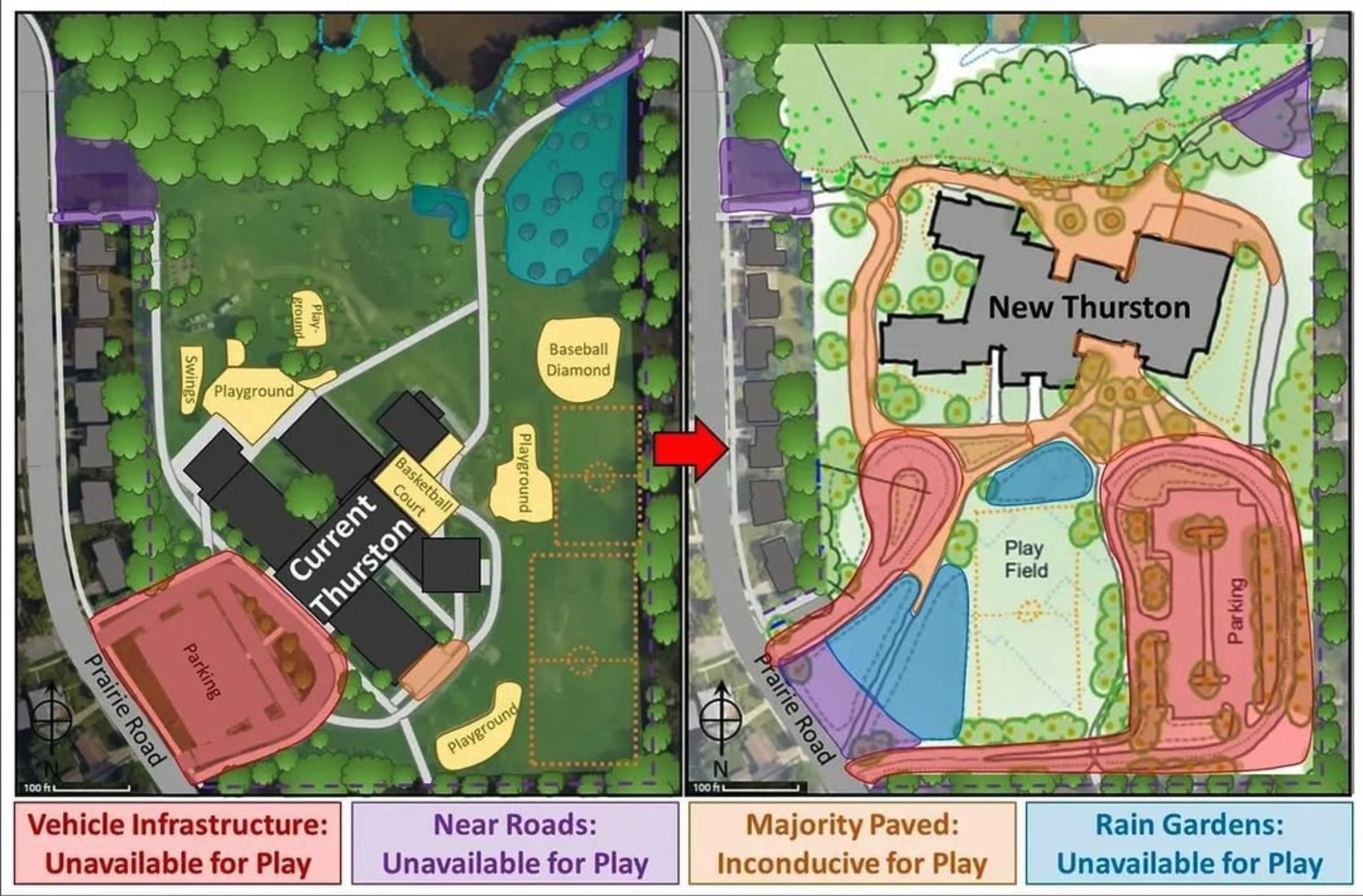
How are students/teachers/parents, the environment, the neighborhood and the city impacted by the planned Thurston Building:
Students:
500 children will study in a school next to an active construction zone for four years, with the constructions fence being 5 feet from their school building and most of their recess area being gone.
Parents of children with sensory sensitivity issues, ADHD and other special needs need to find new schools with adequate programs for their kids who cannot study or even be next to the repeated noise and vibration of construction machinery. This pulls children out of their known environment, and leave parents to manage siblings going to different schools in different neighborhoods depending on where they can find a new place. (from a parent: “I also have a kid who is going to be particularly affected by the construction. He has had a 504 plan and as far as we're concerned, if the current plan for construction becomes reality, they've forced my son out of his assigned public school. My husband and I have told the Board of Ed members multiple times that they'll see an uptick in transfer requests for Thurston kids with sensory-sensitivities, disproportionately those with 504s and IEPs. This is a very foreseeable problem and the board has no plan for handling the outflow of Thurston kids. Despite my direct questions, they've made no assurances that Thurston kids with 504/IEPs will for sure be given spots in their next choice of school, even though they're making it impossible for them to go to their home school. It's all so avoidable and frustrating. It really feels like certain members of the board just don't care.”)
Recess areas will be diminished for good; soccer fields and the baseball diamond are gone.
Classroom vegetable gardens become parking for construction vehicles for the next four years, then a bus lane.
Once students move to the new building, they will have direct access to the remaining forest, marshland, vernal pool and pond, without a direct visual line for teachers to supervise and keep students safe.
While the Nature Center is a wonderful and deeply appreciated part of our neighborhood, it not only houses beautiful Michigan fauna and flora but also ticks, snapping turtles, poison ivy and other plants that can harm children.
The building, located in marshland, will be prone to mold development, and mold mitigation carries its own problems because of chemicals used. This is especially bad for children with Asthma and other respiratory diseases.
The fire lane will be built on top of constantly shifting soil, even the walkway on Prairie Street next adjacent to the lane has uneven concrete slaps, over time, this might become a safety issue should there ever be a case of fire or other emergencies needing heavy trucks to be accommodated.
The new smaller designated outside areas for students to use at recess are framed by a huge parking lot with a ring road, a bus lane with a loop close to the school and the school building itself.
Teachers who can, will continue to leave the school district. The fall-out from the $25 Million budget deficit accounts for much higher healthcare and benefit costs each teacher has to pay. Salaries become less and less competitive with nearby school districts. Teachers, trying to have some input in saving the Thurston Nature Center or permanent stages for elementary schools are ignored; this will result in more teachers leaving and teachers becoming less enthusiastic about their work, especially when teaching with an active construction site right next to their class rooms for several years.
Environment:
A lawsuit filed to pause construction was rejected by Judge Patrick Conlin, and the established oak savannah has been severely decimated. The raingardens, butterfly way station, many trees and other features of the nature center are dismantled and cut down, with volunteers and neighbors trying to mitigate the fall-out by moving plants and rebuilding part of the butterfly way station on another site. 60 years of developing and maintaining this unique and historic environmental jewel will be naught.
During construction, noise and vibration of the heavy machinery will drive away many animals from their established homes. The new two-story building on the south side of the reserve will plunge part of the woods in constant shade, changing the environment for good.
Animals holding on in the adjacent area, will be driven away by 500 children being in the direct vicinity every day. Indoor and outdoor lights will impact the center’s nightlife.
Over time, the vibration from the constant use of sump pumps will drive away other remaining animals and loosen root systems.
Trash from 500 kids will find its way into the nature center where it is harder to find and clean and pollutes flora while poisoning fauna.
The planned large water tanks under the new building will have plastic lining and/or casing, releasing microplastics into the soil, the pond and the Millers Creek watershed over time. There is also no information on how the water pumps will be operated as to not drain the pond or established vernal pools.
A temporary road encroaching on the Nature Center has been built for construction and contractor trucks. It will become a concrete road used as a fire lane, a walkway and a thoroughfare for garbage and repair trucks. In winter, this new road will be heavily salted (just as we can see on the new bus lane on Bluett in front of Clague). The salt, both from Bluett Street and from the new road on the northside of Thurston, will go directly into the soil and water of the Thurston Nature Center.
The destruction happening in the next two years cannot be reversed and the Thurston Neighborhood will be more sucseptible to flooding. Climate scientists forecast more intense storms, increased droughts and flooding increasing the risk of erosion and flood damage for Ann Arbor and the whole Great Lakes region.
Neighborhood:
The new building is constructed on marshland above the underground Millers Creek watershed. Over years, neighbors and volunteers have added berms, the rain gardens and other natural features to mitigate repeated flooding in the area, which in the past ruined many basements in the neighborhood.
Until now the Nature Center has been used by scouts for environmental projects, school kids learn about environment and nature during regular classes and summer school and neighbors spend time walking and watching birds (there are 166 species of birds found so far).
Soccer leagues use the fields for practice and families meet with their children on the green and the playgrounds.
As the area surrounding Thurston is built up more and more, green spaces and especially the 60-year-old nature reserve full of native plants become even more important, and Ann Arbor is touting its love and respect for nature and environment.
Millions of our tax dollars were used by the city and Washtenaw County to help stabilize the Millers Creek watershed. Thurston Pond is the head of the watershed which is still one of the two most unstable ones in the Huron River shed system. Neighbors contributed to many fundraisers to maintain the nature center, build natural flood-mitigating measures and dredge the pond. Volunteers sacrificed many weekends to maintain and better the reserve with manual labor. Tax dollars and work hours spent on the Nature Center will have gone to waste. And down the road, more tax money will have to be spent to address flooding, stabilizing the watershed and other issues occurring from building in this location.
Communities feel like they don’t matter: the promised opportunities for neighbors and parents to become involved in the planning for new schools never happened.
Ann Arbor’s communication managers tout the nature-friendly and sustainable plan for the city, at the same time, they stay quiet on AAPS’s plan to destroy places like the 60 year-old Thurston Nature Center and the city park adjacent to Lawton School.
City:
In the past, the city – and Washtenaw County – has invested millions of dollars to build up the Thurston Nature Center and prevent further neighborhood flooding through environmental measures like berms (on the TNC page, scroll down to July/August 2023), rain gardens and stabilizing the Millers Creek watershed.
But not only has the city administration stayed silent about their (our!) tax money being wasted, they also nonchalantly forgot the neighborhood’s financial stake: in 2015, Thurston raised $40.000 to dredge the Pond. In 2019, AAPS District News, the school district’s newsletter, boasted that the Thurston Nature Center had received the Environmental Excellence Award, in great part because of its pond.
On June 9, 2025, the city announced it has been named to the 2024 CDP A List, the top status available from the largest global independent environmental disclosure system, recognizing global leadership in environmental transparency, climate action and resilience planning. This while staying silent while AAPS is destroying places like the Thurston Nature Center.
Instead - and after just adopting the Natural Features Resolution on May 22. 2025 - the city decided to give over the Thurston Nature Center’s South Prairie (city-owned land and developed and grown with tax money) to AAPS to become an impervious surface road. When Thurston Neighbors filed a lawsuit trying to preserve the South Prairie, Judge Conlin ruled that you cannot foresee that the construction and use of a concrete road would do irreparable harm to the natural and established South Prairie and therefore could be built.
Adding the destruction of the city park adjacent to Lawton School and euthanizing a Beaver Family near the Leslie Science Center (June 2025), Ann Arbor is on its way to loose its reputation as the proactive and sustainable tree town, offering an environmentally conscientious place to live.
What did neighbors do?
This spring of 2025, LetThurstonPlay started a fundraiser for a legal fund to take on the interests of neighbors wanting to save the Thurston Nature Center as much as still possible. By June, $17,507 had been raised.
Many neighbors also petitioned the city by mail and email not to sell the South Prairie or allow for it to be paved over.
In early June, neighbors filed two separate lawsuits hoping for an injunction and a reset on plans for the Thurston construction and for keeping the South Prairie intact. Sadly, both cases were heard by Judge Conlin on June 24, and dismissed. The second case was filed against AAPS hoping to save trees at the Logan and Thurston Elementary School sites. His opinion there was that it is too late after the bond was voted on in 2019. But, as the timeline shows, neighbors did not have enough information until just a short time before construction started and the vote was made for a proposal very different than what is happening now.
In their letters to the city and to support the lawsuits, neighbors tried to show how AAPS’s board is conducting itself: omitting information and misrepresenting issues. Here are a couple of examples:
The wetland delineation for the new Thurston building was already done in November 2022, but one month later, in December, the superintendent still talked about a new school for the Northeast side of town and the Domino’s Farm building becoming a preschool for the NE area. No explanation was given for a change of plans, it was only recognized that AAPS stepped away from purchasing the land for the new elementary school. As said before, the office building, supposed to be a preschool, is only used for administrators, with a mostly empty parking lot every work day (there is no public transportation going to the building). The main reason now given for Thurston’s new building in the wetlands instead of the old place is the room needed for the preschool and a growing student body.
AAPS is publishing maps of Thurston that are not precise. A map from the Logistics and Phasing Plan for Thurston from January 2025 shows the actual temporary construction road encroaching further into the nature center than the map AAPS published.
Another issue neighbors try to bring attention to is the disrespect Gilbane Construction has for the communities and neighborhoods in Ann Arbor. In addition to the witnessed disrespect at the Thurston neighborhood meeting in September of last year, is has come to light that Gilbane has an office in the AAPS office building at Domino’s Farms and that by contract they are only responsible for their buildings for one year after construction is completed. Meaning AAPS, and therefore taxpayers, will pay for anything needed to be replaced or rebuild after the first year of use. Gilbane has a long history of lawsuits including having been convicted of paying briberies and not paying subcontractors. And again, there was no public bidding process to select a contractor for the $1 Billion project.
The Thurston Nature Center website shows how many student and scout events usually take place teaching children about the environment. AAPS used the quiet quarantine time of the pandemic to make the public believe that the area is not used or cherished by most neighbors. This is far from the truth.